Sigsbee
Mariners' Museum, Uncurated Search Results
Type: Skipjack
Year: 1901
Builder: Charles Anderson
Location: Deal Island

These records are found in the online catalog of The Mariners’ Museum and Park in Newport News, Virginia. Uncurated search results are presented to give researchers and interested readers an idea of whether the museum’s archives contain information about this vessel and whether it may be worthwhile to visit the museum’s catalog search page for further investigation. Uncurated results may be inaccurate or incomplete.
Search mode: Exact Name. Search phrase(s): "Sigsbee". Results returned: 33. Results displayed in this table: 33.
Use these buttons to send uncurated search results to your own app or text document for further research. First, check the box for any row, or click "Select All" then uncheck any rows. Then click "Show Selections". You can then copy your selections from the text box and past them into your app.
| Fetch? | Row ID | Media | Date | Vessel | Place | Related Places | Inscription/Marks | Subject | Notes | Archive Number |
|---|---|---|---|---|---|---|---|---|---|---|
| 1 | No image URL. | Sigsbee (Destroyer : DD-502). | Contains black and white photographs. | MS0817/01-12.084 | ||||||
| 2 | 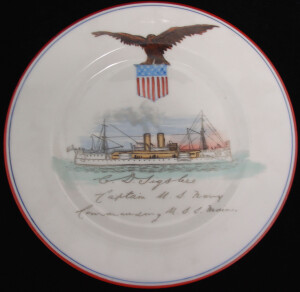 | SHORT DESCRIPTION: Ceramic plate with red, white and blue border around edge. At top is wingspread eagle perched on American shield. Beneath that is the starboard side view of a warship and an inscription. NOTES: Purchased by the donor in England. VESSEL INFORMATION-- VESSEL NAME: USS MAINE SERVICE DATES: 1888-1898 DATE WRECKED: February 15, 1898 SHIP BUILDER: U.S. Navy Yard SHIP LINE: U.S. Navy BUILDER LOCATION: New York, New York VESSEL HISTORY: Blown up in Havana Harbor, Cuba, February 15, 1898. Wreck later raised and towed to sea where it was sunk on March 16, 1912. MAJOR EVENT: Spanish-American War CAPTAINS OR OTHER RELATED PEOPLE: SHIP OWNERS: U.S. Navy ENGING BUILDER AND LOCATION: VESSEL DIMENSIONS: 6682 tons; 318' x 27' x 216' | CL5191 | |||||||
| 3 | 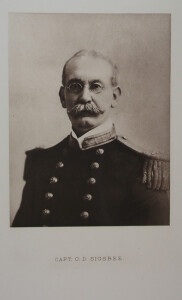 | NOTES: Captain Charles D. Sigsbee commanded USS Maine at the time of her destruction on February 15, l898 in Havana Harbor. After the outbreak of the Spanish-American War, he was given command of the auxiliary cruiser ST. PAUL on May 5, l898. VESSEL INFORMATION-- VESSEL NAME: USS MAINE SERVICE DATES: 1888-1898 DATE WRECKED: February 15, 1898 SHIP BUILDER: U.S. Navy Yard SHIP LINE: U.S. Navy BUILDER LOCATION: New York, New York VESSEL HISTORY: Blown up in Havana Harbor, Cuba, February 15, 1898. Wreck later raised and towed to sea where it was sunk on March 16, 1912. MAJOR EVENT: Spanish-American War CAPTAINS OR OTHER RELATED PEOPLE: SHIP OWNERS: U.S. Navy ENGING BUILDER AND LOCATION: VESSEL DIMENSIONS: 6,682 tons; 319' x 57' x 21'6" | CL7769 | |||||||
| 4 | 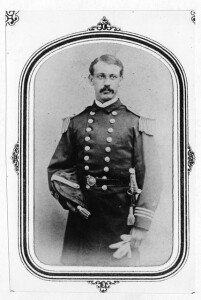 | Sigsbee, Charles D. Acting Midshipman, September 27, 1859. Ensign, October 1, 1863. Master, May 10, 1866. Lieutenant, February 21, 1867. Lieutenant Commander, March 12, 1868. Spanish War, 1898. Sigsbee, Charles Dwight, 1845-1923. Commander Captain, Rear Admiral. Took part in battle of Mobile Bay and bombardment of Fort Fisher, Civil War. Was in command of the battleship MAINE when she was blown up in Havana Harbor 1898. Later, commanded the ST.PAUL and TEXAS. | Portrait of Charles Dwight Sigsbee in Navy uniform with mustache and hat. | P0005/-#U-PP0443 | ||||||
| 5 | 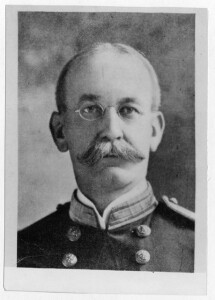 | Sigsbee, Charles D. Acting Midshipman, September 27, 1859. Ensign, October 1, 1863. Master, May 10, 1866. Lieutenant, February 21, 1867. Lieutenant Commander, March 12, 1868. Spanish War, 1898. Sigsbee, Charles Dwight, 1845-1923. Rear Admiral, U.S. Navy. Took part in battle of Mobile Bay and bombardment of Fort Fisher, Civil War. Was in command of the battleship MAINE when she was blown up in Havana Harbor 1898. Later, commanded the ST.PAUL and TEXAS. | Portrait of Charles Dwight Sigsbee in Navy uniform with mustache and glasses. | P0005/-#U-PP0442 | ||||||
| 6 | 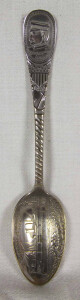 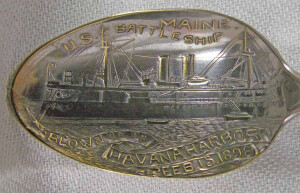 | VESSEL INFORMATION-- VESSEL NAME: Maine SERVICE DATES: 1888-1898 DATE WRECKED: February 15, 1898 SHIP BUILDER: U.S. Navy Yard SHIP LINE: U.S. Navy BUILDER LOCATION: New York, New York VESSEL HISTORY: Blown up in Havana Harbor, Cuba, February 15, 1898. Wreck later raised and towed to sea where it was sunk on March 16, 1912. MAJOR EVENT: Spanish-American War CAPTAINS OR OTHER RELATED PEOPLE: SHIP OWNERS: U.S. Navy ENGING BUILDER AND LOCATION: VESSEL DIMENSIONS: 6682 tons; 318' x 27' x 216' | CL22395 | |||||||
| 7 | 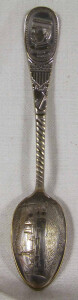 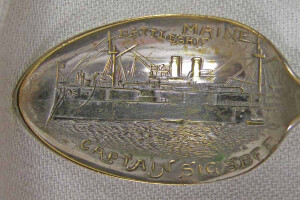 | VESSEL INFORMATION-- VESSEL NAME: Maine SERVICE DATES: 1888-1898 DATE WRECKED: February 15, 1898 SHIP BUILDER: U.S. Navy Yard SHIP LINE: U.S. Navy BUILDER LOCATION: New York, New York VESSEL HISTORY: Blown up in Havana Harbor, Cuba, February 15, 1898. Wreck later raised and towed to sea where it was sunk on March 16, 1912. MAJOR EVENT: Spanish-American War CAPTAINS OR OTHER RELATED PEOPLE: SHIP OWNERS: U.S. Navy ENGING BUILDER AND LOCATION: VESSEL DIMENSIONS: 6682 tons; 318' x 27' x 216' | CL22396 | |||||||
| 8 | No image URL. | Marine artists–Biography–United States | Anton Otto Fischer, marine artist : __his life and work __by Katrina Sigsbee Fischer in collaboration with Alex A. Hurst | LB17183 | ||||||
| 9 | No image URL. | Maine (Battleship : 1895). | The "Maine" : __an account of her destruction in Havana harbor __the personal narrative of Captain Charles D. Sigsbee, U.S.N | LB13690 | ||||||
| 10 | 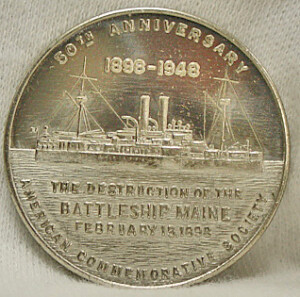 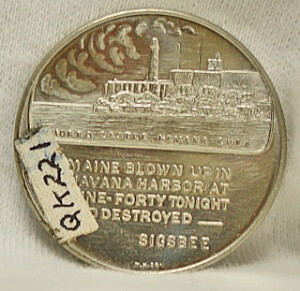 | SHORT DESCRIPTION: Starboard broadside view of the battleship showing damage to the hull. On the reverse, in a cartouche is a view of Morro Castle and a lighthouse with clouds above. LABEL COPY: MEDALLION Nickel silver medallion commemorating the destruction of the USS MAINE "American Commemorative Society 1948 QK 221 VESSEL INFORMATION-- VESSEL NAME: USS MAINE SERVICE DATES: 1888-1898 DATE WRECKED: February 15, 1898 SHIP BUILDER: U.S. Navy Yard SHIP LINE: U.S. Navy BUILDER LOCATION: New York, New York VESSEL HISTORY: Blown up in Havana Harbor, Cuba, February 15, 1898. Wreck later raised and towed to sea where it was sunk on March 16, 1912. MAJOR EVENT: Spanish-American War CAPTAINS OR OTHER RELATED PEOPLE: SHIP OWNERS: U.S. Navy ENGING BUILDER AND LOCATION: VESSEL DIMENSIONS: 6682 tons; 318' x 27' x 216' | CL724 | |||||||
| 11 | 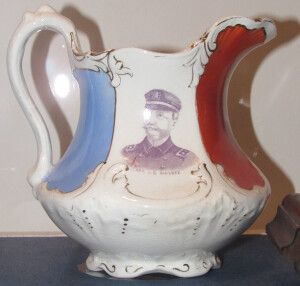 | SHORT DESCRIPTION: Victorian molded pitcher shape with red and blue panels. Purple tinted transfer print designs of the USS MAINE with inscription. On the other side is a portrait of Captain C. D. Sigsbee. NOTES: La Belle China was a variety of cream colored ware produced by athe Wheeling Pottery Company, the mark first being used in 1893. (Barber, Edwin Atlee, MARKS OF AMERICAN POTTERS, p. 149-150) LABEL COPY: Pitcher, circa 1898 The Mariners' Museum FN 710 (Collections Gallery Fall 1998 VESSEL INFORMATION-- VESSEL NAME: USS MAINE SERVICE DATES: 1888-1898 DATE WRECKED: February 15, 1898 SHIP BUILDER: U.S. Navy Yard SHIP LINE: U.S. Navy BUILDER LOCATION: New York, New York VESSEL HISTORY: Blown up in Havana Harbor, Cuba, February 15, 1898. Wreck later raised and towed to sea where it was sunk on March 16, 1912. MAJOR EVENT: Spanish-American War CAPTAINS OR OTHER RELATED PEOPLE: SHIP OWNERS: U.S. Navy ENGING BUILDER AND LOCATION: VESSEL DIMENSIONS: 6,682 tons; 319' x 57' x 21'6" | CL5368 | |||||||
| 12 |  | SHORT DESCRIPTION: Spoon with images and text commemorating the sinking of the Battleship Maine in Havana Harbor on February 15, 1898. Bowl interior has image of the battleship Maine as seen from a port view. Two small boats are alongside the vessel in the foreground. The top, front of the spoon's handle has image of Captain Sigsbee (profile, left side of face) encircled by oval bead design. "Captain Sigsbee" is just below the image of the man. Underneath this are a shield surrounded by decorative motifs and a anchor. A rope design begins mid-way down the handle and continues to the edge of the bowl. VESSEL INFORMATION-- VESSEL NAME: Maine SERVICE DATES: 1888-1898 DATE WRECKED: February 15, 1898 SHIP BUILDER: U.S. Navy Yard SHIP LINE: U.S. Navy BUILDER LOCATION: New York, New York VESSEL HISTORY: Blown up in Havana Harbor, Cuba, February 15, 1898. Wreck later raised and towed to sea where it was sunk on March 16, 1912. MAJOR EVENT: Spanish-American War CAPTAINS OR OTHER RELATED PEOPLE: SHIP OWNERS: U.S. Navy ENGING BUILDER AND LOCATION: VESSEL DIMENSIONS: 6682 tons; 318' x 27' x 216' | CL25281 | |||||||
| 13 | No image URL. | Navigation. | Fold pl., diagrams. | LB75307 | ||||||
| 14 | No image URL. | Sailors.; Navigation. | Progressive naval seamanship. | LB56234 | ||||||
| 15 | No image URL. | Fallacy in composite great circle sailing. | LB51512 | |||||||
| 16 | No image URL. | Navigation.; Aids to navigation. | Another graphic solution in coast navigation. | LB75306 | ||||||
| 17 | No image URL. | Sigsbee's improved parallel rule. | LB77410 | |||||||
| 18 | 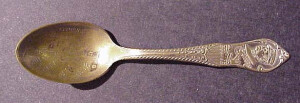 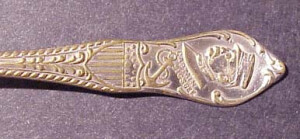 | FLAGSHIP OLYMPIA | CL26949 | |||||||
| 19 |  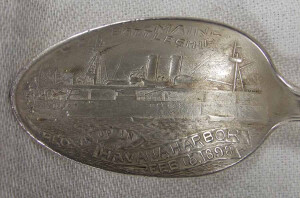 | VESSEL INFORMATION: VESSEL NAME: MAINE VESSEL BUILT: 1898 SHIP'S CAPTAIN: SIGSBEE SHIP'S HISTORY: Blown up in Havana Harbor on February 15, 1898. | CL1659 | |||||||
| 20 | No image URL. | G. S. Blake (Steamboat : 1874). | Deep-sea sounding.; Dredges. | Deep-sea sounding and dredging : __supplement to a description and discussion of the methods and appliances used on board the Coast and Geodetic Survey Steamer, "Blake." __by Charles D. Sigsbee | LB10332 | |||||
| 21 | 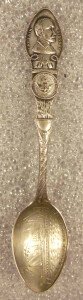 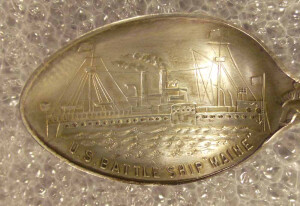 | SHORT DESCRIPTION: In the bowl appears a starboard side view of the battleship USS MAINE and the inscription U.S. BATTLESHIP MAINE. At the top of the handle is a portrait of Captain Sigsbee below which appears the seal of the U.S. Navy and two guns. On the shank of the handle is imprinted: WE MOURN OUR LOSS. On the reverse side appears a hallmark and STERLING. At the top of the handle are the initials I H L to stand for Isobel H. Lenman, cousin of the donor. VESSEL INFORMATION-- VESSEL NAME: USS MAINE SERVICE DATES: 1888-1898 DATE WRECKED: February 15, 1898 SHIP BUILDER: U.S. Navy Yard SHIP LINE: U.S. Navy BUILDER LOCATION: New York, New York VESSEL HISTORY: Blown up in Havana Harbor, Cuba, February 15, 1898. Wreck later raised and towed to sea where it was sunk on March 16, 1912. MAJOR EVENT: Spanish-American War CAPTAINS OR OTHER RELATED PEOPLE: SHIP OWNERS: U.S. Navy ENGING BUILDER AND LOCATION: VESSEL DIMENSIONS: 6682 tons; 318' x 27' x 216' | CL1909 | |||||||
| 22 | 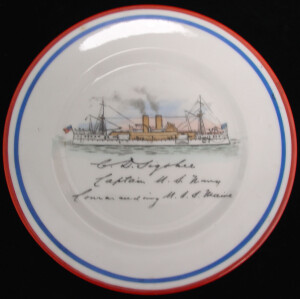 | SHORT DESCRIPTION: White china plate with red an blue banded border and a transfer print of the USS MAINE in the center with an inscription. VESSEL INFORMATION-- VESSEL NAME: USS MAINE SERVICE DATES: 1888-1898 DATE WRECKED: February 15, 1898 SHIP BUILDER: U.S. Navy Yard SHIP LINE: U.S. Navy BUILDER LOCATION: New York, New York VESSEL HISTORY: Blown up in Havana Harbor, Cuba, February 15, 1898. Wreck later raised and towed to sea where it was sunk on March 16, 1912. MAJOR EVENT: Spanish-American War CAPTAINS OR OTHER RELATED PEOPLE: SHIP OWNERS: U.S. Navy ENGING BUILDER AND LOCATION: VESSEL DIMENSIONS: 6682 tons; 318' x 27' x 216' | CL5336 | |||||||
| 23 | 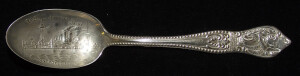 | VESSEL INFORMATION-- VESSEL NAME: USS MAINE SERVICE DATES: 1888-1898 DATE WRECKED: February 15, 1898 SHIP BUILDER: U.S. Navy Yard SHIP LINE: U.S. Navy BUILDER LOCATION: New York, New York VESSEL HISTORY: Blown up in Havana Harbor, Cuba, February 15, 1898. Wreck later raised and towed to sea where it was sunk on March 16, 1912. MAJOR EVENT: Spanish-American War CAPTAINS OR OTHER RELATED PEOPLE: SHIP OWNERS: U.S. Navy ENGING BUILDER AND LOCATION: VESSEL DIMENSIONS: 6,682 tons; 318' x 27' x 216' | CL1929 | |||||||
| 24 | 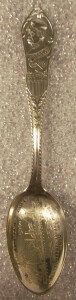 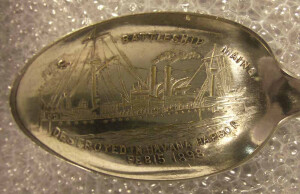 | VESSEL INFORMATION-- VESSEL NAME: USS MAINE SERVICE DATES: 1888-1898 DATE WRECKED: February 15, 1898 SHIP BUILDER: U.S. Navy Yard SHIP LINE: U.S. Navy BUILDER LOCATION: New York, New York VESSEL HISTORY: Blown up in Havana Harbor, Cuba, February 15, 1898. Wreck later raised and towed to sea where it was sunk on March 16, 1912. MAJOR EVENT: Spanish-American War CAPTAINS OR OTHER RELATED PEOPLE: SHIP OWNERS: U.S. Navy ENGING BUILDER AND LOCATION: VESSEL DIMENSIONS: 6682 tons; 318' x 27' x 216' | CL703 | |||||||
| 25 | 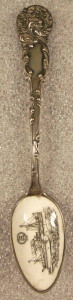 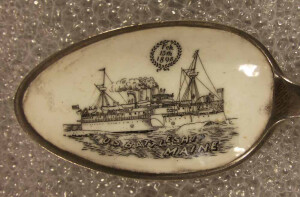 | SHORT DESCRIPTION: Obverse: in the enameled bowl appears a starboard bow view of the Maine and the inscription U.S. BATTLESHIP MAINE FEB. 15, 1898; Reverse: Hallmark R, STERLING PAT. JAN. 10, 1893. VESSEL INFORMATION: VESSEL NAME: USS MAINE VESSEL BUILT: 1888 SHIP'S CAPTAIN: SIGSBEE VESSEL DIMENSIONS: 6,682 TONS SHIP'S HISTORY: Blown up in Havana Harbor, Havana, Cuba on February 15, 1898. | CL1788 | |||||||
| 26 | No image URL. | NOTES: Naval Officers, U.S. (Spanish American War). | CL18464 | |||||||
| 27 | No image URL. | G. S. Blake (Steamboat : 1874). | Deep-sea sounding.; Dredges. | At head of title: United States Coast and Geodetic Survey. Carlile P. Patterson, superintendent. | LB101467 | |||||
| 28 | 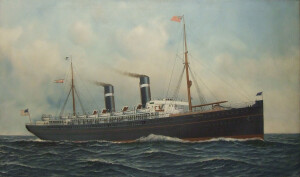 | INVENTORY: frame - there is one (1) component part. VESSEL INFORMATION- SHIPBUILDER: WILLIAM CRAMP & SONS SHIPBUILDER LOCATION: PENNSYLVANIA, PHILADELPHIA BUILD DATE: 1895 SHIPOWNER: INTERNATIONAL NAVIGATION CO.; INTERNATIONAL MERCANTILE MARINE CO. (1902) VESSEL DIMENSIONS: 535'5" x 63' x 26'8", 11,629 GROSS TONS, 5874 NET TONS VESSEL HISTORY: Used as a cruiser during the Spanish-American War. Capt. C. D. Sigsbee commanded the ST. PAUL from May 5, 1898 till the end of the War. DATE OF WRECKING, SCRAPPING, ETC.: 1923 Alternate vessel names: (1) KNOXVILLE (1895); (2) ST. PAUL (1895-1923). | CL11588 | |||||||
| 29 | 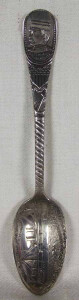 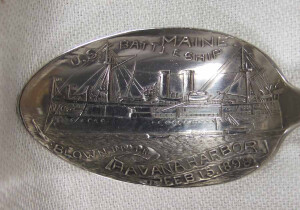 | SHORT DESCRIPTION: Silver souvenir spoon of the battleship MAINE | CL21187 | |||||||
| 30 | 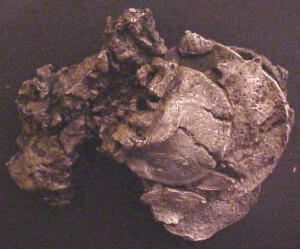 | SHORT DESCRIPTION: The coins appear to be five peseta pieces (similiar to US siver dollars) from the reign of Alfonso XII(1885-1931). The semi-melted clump supports the current theory that the MAINE sank from an internal explosion of her magazine, rather than Spanish mine. NOTES: According to owner, these items were salvaged from the USS MAINE. Some of the salvage crew used the coins to pay their bill at the owners grandfather's restaurant in Norfolk. ADDITIONAL INFORMATION: See object file. LABEL COPY: Coins from the USS MAINE/Whether an underwater mine or a shipboard accident triggered the explosion aboard the USS MAINE, it was the detonation of the ship's magazine that actually caused her sinking. After the Spanish-American War, the Army Corps of Engineers removed the MAINE's hulk from Havana Harbor. This clump of coins, which appears to consist of ca 1890 Spainish silver five pesetas pieces ($1 US) from the reign of King Alfonso XIII, were salvaged from the wreckage. The coins show signs of being exposed to heat flashes and pressures from the explosion of the MAINE's powder magazine. Note the five pesetas coin, not from the MAINE to the right./Gift of Julius L.B. Brown CURATOR'S NOTES: W. Reiss, August 7, 1987… Notes to file - USS MAINE coins The MAINE entered Havana Harbor January 25 and blew up on February 15, 1898 at 9:40 PM. During the 21 days at her mooring, the ship's officers went ashore almost daily to socialize. The crew was kept on board for fear of any problems in a touchy political situation. (Sigsbee, p. 46). On the night of the 15th a series of explosions sank the ship. It was generally thought that a mine beneath the ship caused the magazines to explode. However, many engineers thought it was caused solely by the magazines exploding by accident. It was an important incident leading to the Spanish American War. Congress appropriated funds for the salvage of the ship's remains to recover the crew's bodies, clear the harbor, and determine the cause of the disaster. A large coffer dam was built around the wreck in 37 feet of water and the water was pumped out. In the fall of 1911 the insides of the hull were cleared of bodies, ammunition, and debris. The bow, damaged from explosions, was removed and that after 2/3 made watertight. The latter was raised, floated out to deep water and sunk. Homer Ferguson's (of The Mariners' Museum) brothers were involved: Harley B. Ferguson was the Army's engineer in charge, and William B. Ferguson was the naval constructor who represented the Navy at the site. The clump of coins, which appear to be five pesetas pieces (c.$1) from the reign of Alfonso XIII, show signs of being exposed to the heat flashes and pressures from a slow explosion, such as that caused by exploding black or brown powder. Just heat would have melted the coins more to clump them; just pressure would not have melted them. Though the 1898 court, and an inquiry after the salvage, concluded that a mine must have set off the magazine explosion in the MAINE, the latest navy findings conclude, "There is no evidence that a mine destroyed the MAINE" (Rickover, p. 91) ADDITIONAL INFORMATION: 1. Annon, "Raising the Wreck of the United States Battleship MAINE (Lackawanna, 1914?) TMM ref. #E721.6/L14. 2. Rickover, H.G., "How the Battleship MAINE was Destroyed, (Washington, D.C. 1976). TMM ref # E721.6/R5. 3. Sigsbee, Capt. Charles D. The MAINE: An account of her Destruction in Havana Harbor, (New York, 1899). TMM ref# E721.6/S5. VESSEL INFORMATION-- VESSEL NAME: Maine SERVICE DATES: 1888-1898 DATE WRECKED: February 15, 1898 SHIP BUILDER: U.S. Navy Yard SHIP LINE: U.S. Navy BUILDER LOCATION: New York, New York VESSEL HISTORY: Blown up in Havana Harbor, Cuba, February 15, 1898. Wreck later raised and towed to sea where it was sunk on March 16, 1912. MAJOR EVENT: Spanish-American War CAPTAINS OR OTHER RELATED PEOPLE: SHIP OWNERS: U.S. Navy ENGING BUILDER AND LOCATION: VESSEL DIMENSIONS: 6682 tons; 318' x 27' x 216' | CL22391 | |||||||
| 31 | 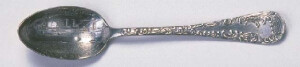 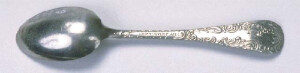 | SHORT DESCRIPTION: Spoon with image and text commemorating the sinking of the Battleship Maine in Havana, Cuba on February 15, 1898. Image of battleship is detailed on the interior bowl of the spoon. Two small boats can be seen alongside the ship in the foreground. The handle of the spoon, on front and back, is covered with decorative motifs (from the end of the handle to near where the bowl joins the handle). | CL25282 | |||||||
| 32 | 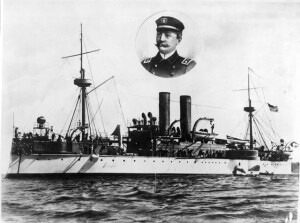 | WRITTEN ON RECTO: USS MAINE AND CAPTAIN C.D. SIGSBEE | CURATORS NOTES: USS Maine, a second-class battleship built between 1888 and 1895, was sent to Havana in January 1898 to protect American interests during the long-standing revolt of the Cubans against the Spanish government. In the evening of 15 February 1898, Maine sank when her forward gunpowder magazines exploded. Nearly three-quarters of the battleship's crew died as a result of the explosion. While the cause of this great tragedy is still unsettled, contemporary American popular opinion blamed Spain, and war followed within a few months. Maine's wreck was raised in 1912 to clear the harbor and to facilitate an investigation into the cause of her sinking. Her remains were subsequently scuttled in deep waters north of Havana. | P0005/-#U-PN0489 | ||||||
| 33 | 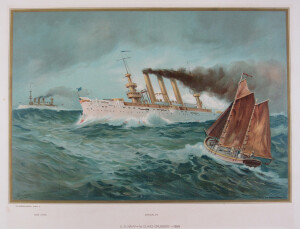 | SHORT DESCRIPTION: Chromolithograph titled 'U.S. Navy 1st Class Cruisers-1899'. Illustration from the book 'The United States Army and Navy Their Histories, From the Era of the Revolution to the Close of the Spanish-American War; with Accounts of their Organization, Administration, and Duties.' 1899, by Lieut. Col. Arthur L. Wagner and Commander J.D. Jerrold Kelley. The collection holds a number of images from this publication: LP 2129 to LP 2141 and LP674 to LP 677. VESSEL INFORMATION- VESSEL NAME: USS NEW YORK VESSEL TYPE: U.S. Navy Armored Cruiser SHIP BUILDER: William Cramp & Sons BUILDER LOCATION: Philadelphia, Pennsylvania VESSEL BUILT: 1891 SERVICE DATES: 1893-1911 VESSEL DIMENSIONS: 384' x 64'10" x 23'3", 8,150 tons displacement VESSEL HISTORY: USS New York (ACR-2) was launched by William Cramp & Sons of Philadelphia on December 2, 1891. Commissioned in 1893, she joined the South Atlantic Squadron, then the European Squadron in 1895, then the North Atlantic Squadron. The ship left Fort Monroe January 17, 1898 to head for Key West when the Spanish American War began. The United States declared war on April 25, 1898, just two days after the date Chapman wrote on this drawing. From the Library of Congress she was the first ship to fire a shot in the Spanish American War on April 27, 1898 against Matanzas. According to the NHHC website, by May she had joined other American ships searching for the Spanish squadron, which it did not find at that time. The ship then attacked San Juan before becoming the flagship of Admiral William Sampson’s squadron and the ship participated in the defeat of the Spanish fleet in the Battle of Santiago on July 3, 1898. Renamed USS SARATOGA on February 16, 1911. Renamed USS ROCHESTER on December 1, 1917. She was eventually scuttled in December 1941 to avoid capture by the Japanese during the attack on Pearl Harbor. MAJOR EVENTS: Spanish-American War, WWI ALTERNATE VESSEL NAMES: (1) USS NEW YORK (1891-1911); (2) USS SARATOGA (1911-1917); (3) USS ROCHESTER (1917-1941) VESSEL INFORMATION- VESSEL NAME: USS Brooklyn (ACR-3) VESSEL TYPE: Armored Cruiser BUILDER: William Cramp & Sons BUILDER LOCATION: Pennsylvania, Philadelphia VESSEL DIMENSIONS: 9215 long tons, 402'7" x 64'8" x 24' ENGINE BUILDER: Engine Building Company of Philadelphia SERVICE DATES: Laid down August 2, 1893. Launched October 2, 1895. Commissioned December 1, 1896. FATE: Decommissioned March 9, 1921. Sold for scrap December 20, 1921. VESSEL HISTORY: [From Dictionary of American Naval Fighting Ships] The second Brooklyn (CA-3) (Armored Cruiser Number 3), was a first rate armored cruiser launched 2 October 1895 by William Cramp and Sons and Engine Building Company, Philadelphia, Pa. Her keel was laid 2 August 1893. She was sponsored by Miss Ida May Schieren, daughter of the Honorable Charles A. Schieren, Mayor of Brooklyn, New York and commissioned 1 December 1896, Captain F. A. Cook in command. Brooklyn was originally armed with eight 8-inch .35 caliber guns; twelve 5-inch .40 caliber guns; twelve 6-pounders; four 1-pounders; and five 18-inch surface torpedo tubes. The maximum thickness of her armor was eight inches. Two of her four eight-inch turrets were experimentally powered by electricity instead of steam. They operated with such marked success that installations of a similar type were ordered for battleships Kearsarge, Kentucky, Illinois, and Alabama. Brooklyn's first assignment was a special service cruise to Great Britain with representatives of the United States for the Diamond Jubilee of Queen Victoria. She departed Southampton 6 July 1897 and returned to New York the 17th. She cruised along the eastern seaboard and in West Indies until becoming flagship of Commodore W. S. Schley's Flying Squadron on 28 March 1898. The Flying Squadron arrived at Cienfuegos, Cuba, 21 May 1898 and established the blockade of that port. On 26 May the Squadron arrived at Santiago, Cuba, where the Spanish Fleet was being held behind the protection of the forts. Brooklyn was a key vessel in the Battle of Santiago (3 July 1898) in which the Spanish Fleet was destroyed. Although she was struck 20 times by whole shot, Brooklyn suffered only one man wounded and one man killed. Brooklyn returned to Tompkinsville, N.Y., 20 August 1898; cruised along the Atlantic coast and in Caribbean waters; participated in the Spanish-American War Victory Celebration at New York 5 October 1899 and sailed via the Suez Canal to Manila, Philippine Islands, where she arrived 16 December 1899. She became flagship of the Asiatic Squadron and participated in the North China Relief Expedition (8 July-11 October 1900) and made a cruise to Australia and Dutch East Indies (10 April-7 August 1901). She remained with the Asiatic Squadron until 1 March 1902, when she sailed for the United States via the Suez Canal and arrived at New York Navy Yard 1 May. On 20 May 1902 Brooklyn was at Havana, Cuba, for the ceremonies to transfer the authority on that Island from the United States Government to the Cuban Government. During June and July she was on special duty in connection with the obsequies of the late British Ambassador to the United States, Lord Paucefote. During the next four years she cruised with the North Atlantic Fleet and the European Squadron, returning to New York 25 May 1905. On 7 June 1905, as flagship of Rear Admiral C. D. Sigsbee, she sailed for Cherbourg, France, where the remains of the late John Paul Jones were received aboard and brought to America. Upon arrival at Annapolis, Commodore Jones' remains were transferred ashore to a receiving vault at the Naval Academy with appropriate ceremonies 23 July 1905. On 16 May 1906, following a naval militia cruise (3-23 August 1905) and a tour in the Mediterranean (28 December 1905-8 May 1906), Brooklyn went into reserve at League Island Navy Yard. Except for a short period (30 June-2 August 1906) in commission for special service at Havana, Cuba, she remained in reserve until the spring of 1907. During 12 April-4 December 1907 Brooklyn served as part of the permanent display at Jamestown Exposition, Jamestown, Va. Following her return to Philadelphia, Brooklyn went into reserve 21 December 1907. Placed out of commission 23 June 1908, she was commissioned in ordinary 2 March 1914. She was assigned to the Atlantic Reserve Fleet and served as receiving ship at Boston Navy Yard (24 July 1914-13 March 1915). She was placed in full commission at Philadelphia 9 May 1915 and served on Neutrality Patrol around Boston harbor until November, when she sailed to the Asiatic station where she served as flagship for the Commander-in-Chief. She attended to regular military and diplomatic duties in China, Japan, and Russia until September 1919 when she became the flagship of Commander, Division 1, Asiatic Fleet. In January 1920 she was assigned to the Pacific Fleet as flagship of Commander, Destroyer Squadrons, and remained there until 15 January 1921. Brooklyn was placed out of commission at Mare Island Navy Yard 9 March 1921 and sold for scrap on 20 December 1921 to G. W. Pigman. | CL20078 |
Created 2026 by Don Barker, CBMM volunteer, for the Chesapeake Shipbuilding Project. shipbuilding@sailingworkboats.es